Auroras where they were never seen: why pink and green skies keep flooding social media, and how not to miss the next one
In recent years, people far from the poles have shared photos of auroras over their towns. The reason is the Sun, which is going through an intense phase of its cycle. Here's what auroras are, why your phone sees them better than your eyes, and how to follow the alerts.
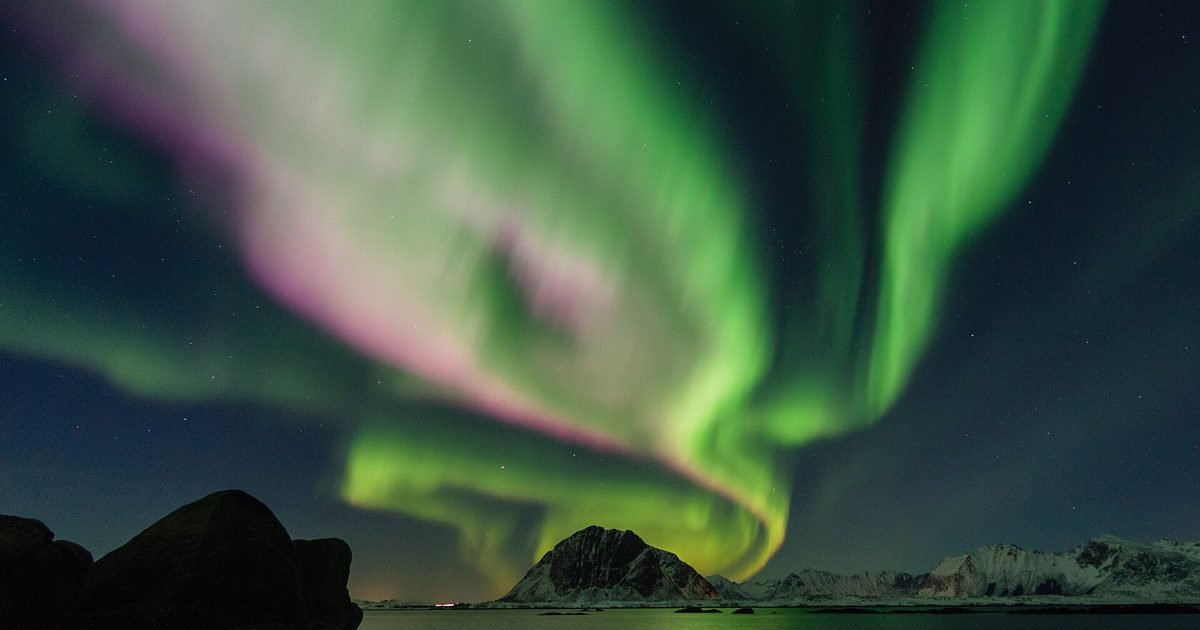
Photo: Wikimedia Commons · CC0
Until recently, seeing the northern lights meant traveling to Norway, Iceland, Finland or Canada. But in recent years there have been repeated, astonishing scenes: pink, red and green skies photographed from mid-latitude places in Europe and North America, and southern lights seen from parts of southern South America, Australia and New Zealand. The images go viral within hours. What's going on?
What an aurora is
The Sun constantly gives off a stream of charged particles called the solar wind. Sometimes it also hurls huge clouds of plasma known as coronal mass ejections. When those particles reach Earth, the planet's magnetic field funnels them toward the poles. There they collide with oxygen and nitrogen atoms in the atmosphere, which release that energy as light.
The color depends on the gas and the altitude: oxygen produces the classic green and, higher up, red; nitrogen adds blues and purples. That's why auroras seen from lower latitudes are often reddish or pink: what we're seeing is the highest part of the display, peeking above the horizon.
Why they're appearing farther from the poles
The Sun has an activity cycle of roughly 11 years. At its peak, there are more sunspots, more flares and more coronal mass ejections. Space agencies said the current cycle reached its maximum around 2024 and 2025, and activity often stays elevated for a while afterward. When a powerful ejection strikes Earth, it triggers an intense geomagnetic storm, and the auroral oval expands to much lower latitudes than usual.
The secret behind the photos: your phone sees more than you do
Many people head outside after seeing photos online and are disappointed: with the naked eye they can only make out a grayish glow or a faint pinkish tint. Yet when they take a picture, vivid colors appear. It isn't a trick: modern camera sensors, especially in night mode, gather light over several seconds and are more sensitive to color than our eyes are in the dark. During faint auroras, the camera captures what the eye can barely detect. In very strong storms, though, the colors can be clearly visible unaided.
How to know when to look
- Follow space weather forecasts. Centers such as NOAA's Space Weather Prediction Center publish alerts and a geomagnetic storm scale from G1 (minor) to G5 (extreme). At mid-latitudes, you usually need a G3 storm or stronger.
- Check the Kp index. It runs from 0 to 9; the higher it is, the farther from the poles the aurora may be visible.
- Use aurora alert apps or follow local astronomers and astronomy clubs on social media, who often post real-time updates.
- Forecasts are uncertain. An ejection takes one to three days to arrive, and how strongly it will hit isn't always clear until the last moment.
Tips for seeing and photographing it
- Find a dark spot away from light pollution, with a clear view of the horizon toward the nearer pole (north in the Northern Hemisphere, south in the Southern).
- Check the weather forecast: clouds are the biggest enemy.
- Give your eyes at least 20 minutes to adjust to the dark.
- Use your phone's night mode, rest it on something steady or a tripod, and skip the flash.
- Be patient: auroras can appear and fade within minutes, with bursts of activity.
- Dress warmly: the best hours are often around midnight.
Are solar storms dangerous?
For people on the ground, no: the atmosphere and the magnetic field protect us. But intense geomagnetic storms can affect satellites, GPS, radio communications and, in extreme cases, power grids. That's why space agencies monitor the Sun continuously, and power and satellite operators have procedures in place for these events.
Beware of fake photos
Every solar storm also brings manipulated or old images presented as new, and even AI-generated auroras over famous landmarks. Before sharing, look for the original source and check whether reliable media or astronomers confirm that auroras were visible in that area.
A show worth looking up for
Auroras remind us that we live next to an active star and that Earth has an invisible shield protecting us. Although solar activity will gradually decline over the next few years, strong storms can still happen. So the next time an alert goes out, it might be worth stepping outside, looking up and, just in case, bringing your phone.
For information only. It does not replace advice from a health professional. Medical disclaimer
You may also like
 Health
Respiratory virus season is here: flu, COVID and RSV, and how to prepare this fall
 Curiosities
Jonathan, the 194-year-old tortoise: what his genes reveal about aging more slowly
 Home remedies
Ginger for nausea: what the evidence says and how to use it safely
 Health
Glucose monitors on your arm: useful for everyone or only for people with diabetes?
 Animals
The Amazon's "ghost dog": the wild canid almost no one has seen, now being revealed by camera traps
 Relationships