The Antikythera mechanism: the 2,000-year-old "computer" that still baffles scientists
It was pulled from a shipwreck in 1901 as a lump of corroded bronze. Today we know it was an astronomical calculator with dozens of gears, something not seen again in Europe for many centuries. Who built it, and why?
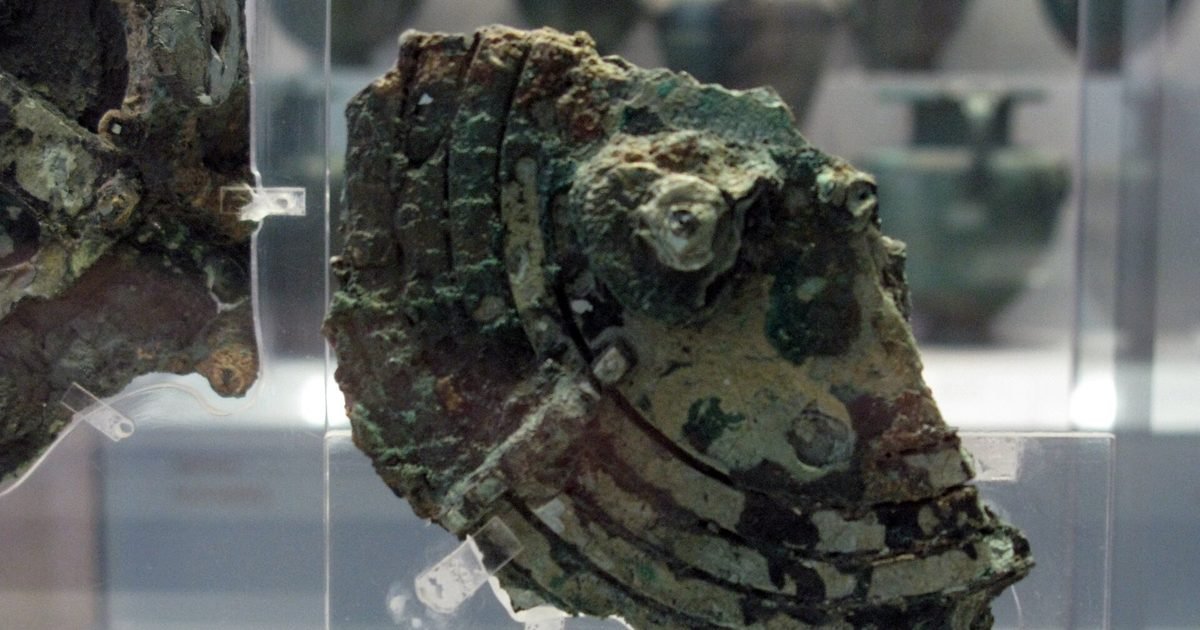
Photo: Tilemahos Efthimiadis from Athens, Greece / Wikimedia Commons · CC BY 2.0
In 1900, a group of Greek sponge divers sheltered from a storm near the small island of Antikythera, between the Peloponnese and Crete. Diving down, they found the remains of a Roman-era ship that had sunk around the first century BC, laden with statues, coins and amphorae. Among the objects recovered the following year were some fragments of bronze and wood that at first attracted little attention. More than a century later, they're considered one of the most astonishing artifacts of the ancient world.
A lump of bronze full of gears
As the fragments dried, they split apart and revealed something unexpected: bronze gearwheels, some with teeth barely a millimeter and a half long. Archaeologist Valerios Stais was among the first to notice it was a mechanism. For decades people argued over what it could be. Some thought it was an astrolabe, others a clock, or even a much more modern object that had fallen into the wreck by accident.
The breakthrough came in the 20th century with British physicist and historian Derek de Solla Price, who used X-rays to study its interior and argued it was an astronomical calculator. Later, in the early 21st century, the Antikythera Mechanism Research Project used high-resolution CT scanning and special surface imaging to read thousands of engraved characters invisible to the naked eye.
What did it do?
Today most researchers agree that the mechanism, probably operated by turning a hand crank, could:
- Show the positions of the Sun and Moon in the zodiac throughout the year.
- Display the phases of the Moon, using a small rotating ball that was half light and half dark.
- Predict solar and lunar eclipses, using cycles known to Babylonian astronomers, such as the roughly 18-year Saros cycle.
- Reproduce the Moon's uneven motion, faster in some parts of its orbit than others, thanks to an ingenious gear arrangement with an offset pin.
- Track the calendar of the Panhellenic games, including the Olympic Games held every four years.
The inscriptions also suggest it showed the positions of the planets visible to the naked eye: Mercury, Venus, Mars, Jupiter and Saturn. In 2021, a team at University College London presented a complete reconstruction of the front face including these planets, though some details remain hypotheses.
Technology ahead of its time
What's most baffling is its complexity. Around 30 gears have been identified in the surviving fragments, and it may originally have had more. Nothing comparable is known from the ancient world. Geared mechanisms of such precision don't reappear in Europe until medieval astronomical clocks, more than a thousand years later.
That has led some to talk of "lost technology." Historians, however, point out that ancient texts mention similar devices, such as the spheres that, according to Cicero, Archimedes built. Others may have existed, but their bronze could have been melted down and reused over time. The Antikythera device may have survived precisely because it lay at the bottom of the sea.
The big remaining mysteries
- Who built it? Nobody knows. There's speculation about workshops linked to Archimedes, to Hipparchus's school on Rhodes or to Posidonius. None of these ideas has been proven.
- When? Estimates range from the third to the first century BC.
- What for? Was it a scientific instrument, a teaching tool, a luxury item for a wealthy Roman collector? Perhaps a bit of each.
- Was it one of a kind? If others existed, none has been found.
No, it wasn't aliens
As with many surprising ancient objects, the Antikythera mechanism sometimes appears in videos and documentaries that credit it to lost civilizations or visitors from other planets. Researchers reject this: the inscriptions are in Greek, the astronomy it models is the astronomy known at the time, and the errors it contains are typical of ancient models. That's exactly what makes it more remarkable: it's proof of human ingenuity.
Where to see it
The original fragments are kept at the National Archaeological Museum in Athens, along with reconstructions that help visitors imagine how it worked. Several teams and hobbyists have built working replicas, and there are online models you can operate from your computer.
A reminder of how much we don't know
The Antikythera mechanism forces us to rethink the idea that technology always advances in a straight line. More than 2,000 years ago, someone managed to fit the sky inside a bronze box. Each new imaging technique reveals hidden details, and there are probably still surprises to come. Until then, it remains one of the most beautiful mysteries in the history of science.
For information only. It does not replace advice from a health professional. Medical disclaimer
You may also like
 Health
Respiratory virus season is here: flu, COVID and RSV, and how to prepare this fall
 Curiosities
Jonathan, the 194-year-old tortoise: what his genes reveal about aging more slowly
 Viral world
The year's funniest animal photos are taking over social media again: the contest that makes us laugh and protect nature
 Home remedies
Ginger for nausea: what the evidence says and how to use it safely
 Health
Glucose monitors on your arm: useful for everyone or only for people with diabetes?
 Animals