Tunguska: the blast that flattened 2,000 km² of Siberian forest without leaving a crater
In 1908, an explosion hundreds of times more powerful than the Hiroshima bomb knocked down some 80 million trees in Siberia. No crater and no large meteorite fragments were ever found. More than a century later, what do we know about what happened?
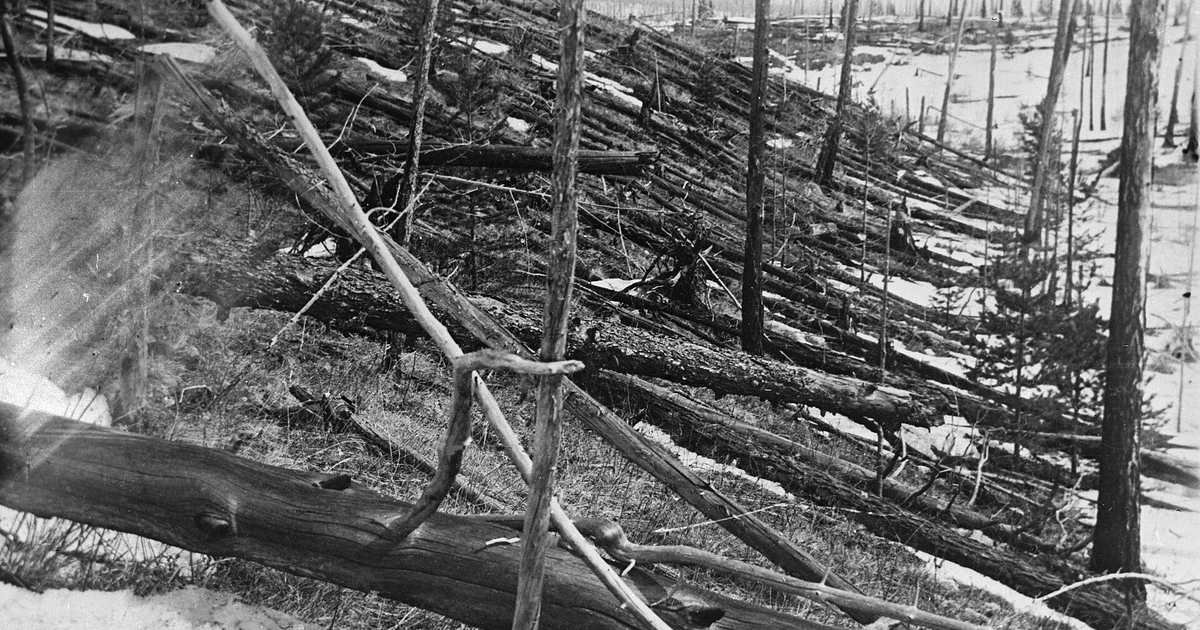
Photo: Wikimedia Commons · Public domain
On the morning of June 30, 1908, people in a remote part of Siberia, near the Podkamennaya Tunguska River, saw a huge fireball streak across the sky, brighter than the Sun. Seconds later, a colossal explosion shook the taiga. Witnesses tens of kilometers away said they were knocked to the ground by the shock wave and felt heat so intense they thought their clothes would catch fire. Seismographs recorded the event thousands of kilometers away and, for several nights, skies over Europe and Asia glowed strangely.
A forest flattened in the shape of a butterfly
Because of the site's remoteness and Russia's political turmoil, no one investigated properly for almost two decades. In 1927, mineralogist Leonid Kulik led the first scientific expedition. He expected to find a big crater and a giant meteorite. What he found was baffling: some 80 million trees knocked down across more than 2,000 square kilometers (about 830 square miles), all pointing outward from a central spot. Later maps showed that the devastated area had a curious butterfly shape.
The strangest part was at the center: there, the trees were still standing, but stripped of branches and bark, like telegraph poles. And there was no crater.
The leading explanation: an explosion in the air
Today most scientists believe an asteroid or comet fragment roughly 50 to 60 meters across entered the atmosphere at high speed. The pressure and heat were so intense that the object broke apart and exploded several kilometers above the ground before reaching the surface. This is known as an airburst.
That would explain the missing crater. It would also explain the standing trees at the center: directly beneath the explosion, the blast wave came from above and stripped the branches but didn't topple the trunks; farther out, it hit sideways and flattened them. Estimates of the energy released vary, but are usually put at around 10 to 15 megatons, hundreds of times the Hiroshima bomb.
Later research found tiny spheres of silicate and magnetite in the soil and in tree resin, consistent with material of cosmic origin.
Asteroid or comet?
That's one of the debates still open. A comet, made mostly of ice and dust, would have vaporized almost completely, which would explain the lack of fragments. A rocky asteroid would be more common, but you'd expect to find more debris. Some studies even suggest the object may have skimmed the atmosphere and bounced back into space after losing part of its mass, though this is a minority view.
It has also been proposed that nearby Lake Cheko could be an impact crater left by a fragment. Other researchers dispute this and argue the lake is older.
The more exotic theories
The missing crater has fueled all sorts of speculation over the decades: a tiny black hole passing through Earth, antimatter, an exploding alien spacecraft or even an experiment by inventor Nikola Tesla. None has scientific support. Explanations based on a natural object exploding in the air fit the evidence far better.
Why Tunguska matters today
Had the object exploded over a major city, it would have caused a catastrophe. That it happened over an almost uninhabited area was sheer luck. Tunguska has become a reminder that Earth is exposed to cosmic impacts, and one reason space agencies now track near-Earth asteroids.
In 2013, a much smaller rock exploded over the Russian city of Chelyabinsk. The shock wave shattered thousands of windows and injured more than a thousand people, mostly from flying glass. It was a small taste of what an airburst can do.
In 2022, NASA's DART mission deliberately crashed into the small asteroid Dimorphos and succeeded in changing its orbit. It was the first real-world test showing that we might be able to deflect a dangerous object if it's spotted early enough.
Asteroid Day
In memory of Tunguska, every June 30 is International Asteroid Day, recognized by the United Nations. Its goal is to raise awareness of impact risks and of the importance of watching the skies.
A mystery with half the answers
More than a hundred years on, we know a great deal about what happened at Tunguska, but not everything. We still don't know for sure what kind of object it was or exactly where it came from. The forest has grown back and the area is now a nature reserve, though trees felled that day can still be seen. It's one of those places where the history of Earth and the history of the cosmos collide in spectacular fashion.
For information only. It does not replace advice from a health professional. Medical disclaimer
You may also like
 Health
Respiratory virus season is here: flu, COVID and RSV, and how to prepare this fall
 Curiosities
Jonathan, the 194-year-old tortoise: what his genes reveal about aging more slowly
 Viral world
The year's funniest animal photos are taking over social media again: the contest that makes us laugh and protect nature
 Home remedies
Ginger for nausea: what the evidence says and how to use it safely
 Health
Glucose monitors on your arm: useful for everyone or only for people with diabetes?
 Animals