Do octopuses dream? The color changes during sleep that fascinate scientists
Videos of octopuses changing color in their sleep have been viewed millions of times. Scientists have found that they have two stages of sleep, one of them surprisingly similar to ours. Here's what we know and what remains a mystery.
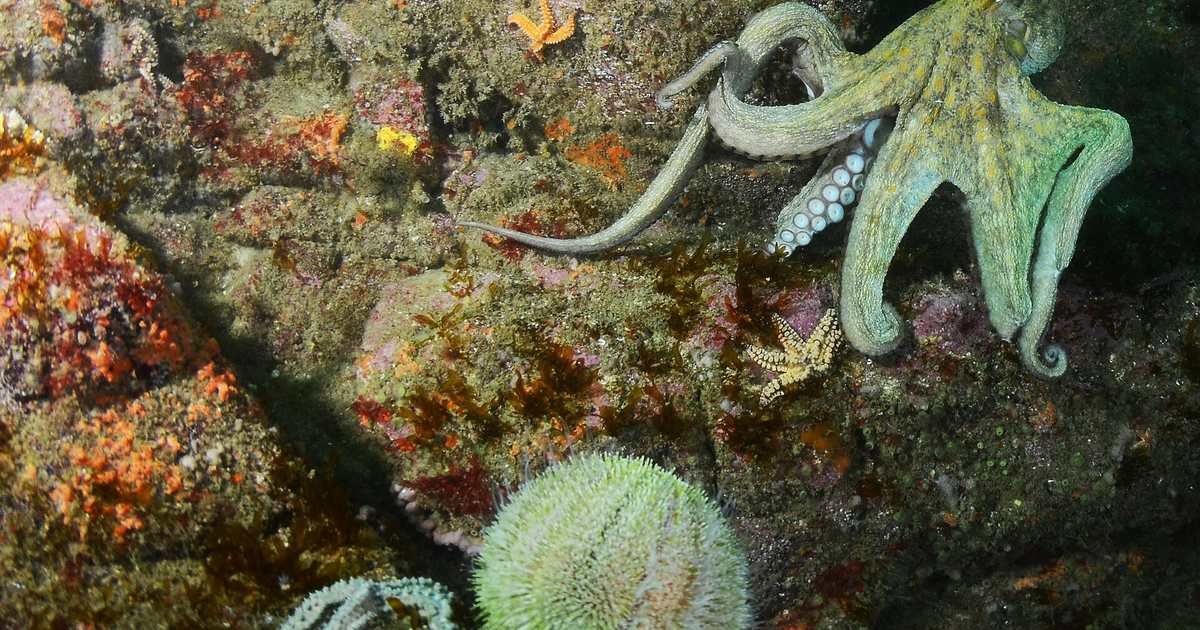
Photo: Xavier Caisey / Wikimedia Commons · CC BY 4.0
On screen, an octopus rests calmly, pale, almost white. Suddenly its skin floods with dark blotches, waves of color ripple across its body, its eyes move and its arms twitch. After a minute, it turns pale and still again. Videos like this, filmed in aquariums and labs, have gone viral with the same question: is it dreaming?
A brain very different from ours
Octopuses are mollusks, relatives of snails and clams, and their lineage split from ours more than 500 million years ago. Even so, they're extraordinarily intelligent animals: they solve puzzles, open jars, escape from tanks and recognize specific people. They have around 500 million neurons, comparable to some mammals, but arranged very differently: about two-thirds are in their arms, which can act with a degree of independence.
So when scientists discovered that octopuses sleep in a way that resembles ours, it came as a surprise. It's an example of what biologists call convergent evolution: similar solutions arising in very distant lineages.
Two kinds of sleep
Several studies, including one published in Nature in 2023 by researchers at the Okinawa Institute of Science and Technology in Japan, have described two stages of sleep in octopuses:
- Quiet sleep: the octopus stays still and pale, with narrowed pupils. This is the main stage.
- Active sleep: occurs in short bursts of about a minute, every so often. During this stage the skin changes color and texture, the eyes and arms move, and brain activity looks similar to when the animal is awake.
The researchers found that when octopuses were prevented from entering active sleep, they later tried to "catch up" on it, something that also happens with sleep in humans. That suggests this stage serves an important purpose.
Is it like our REM sleep?
In humans, REM (rapid eye movement) sleep is when we have our most vivid dreams and when the brain seems to process memories. Octopus active sleep shares some features with it: it happens periodically, the brain is highly active and there's movement. Some scientists have suggested it might help consolidate memories or "review" camouflage patterns learned during the day.
During active sleep, the color patterns an octopus displays resemble those it uses while awake to camouflage itself or communicate. That's why some researchers wonder whether the animal is "running through" those patterns, a bit like rehearsing them while asleep.
So does it dream?
Here scientists are cautious. Dreams, as we understand them, are subjective experiences, and we can't ask an octopus what it went through. What we do know is that its brain is very active and that its body changes in ways that reflect that activity. Some researchers think it's possible that octopuses experience something dreamlike; others prefer not to draw conclusions. For now, the honest answer is: we don't know, but it's a fascinating possibility.
The story of Heidi
One of the most famous clips comes from a documentary in which an octopus named Heidi changes color while sleeping in a researcher's home aquarium. The footage went around the world and sparked huge public interest in the mental lives of cephalopods. Many experts pointed out at the time that reading these changes as specific dreams (for example, that she was dreaming of hunting a crab) is speculation, however charming.
Why it matters how they sleep
Studying sleep in such different animals helps answer a big question: why do we sleep at all? If sleep with similar stages has evolved independently in mammals, birds, reptiles and even octopuses, it likely serves fundamental functions for any complex brain, such as memory and learning.
These findings have also fueled the debate over cephalopod welfare. In some countries, such as the United Kingdom, the law now recognizes octopuses, squid and cuttlefish as sentient beings, and there are ongoing discussions about how they should be treated in research, fishing and aquaculture.
More octopus facts
- They have three hearts and blue blood, thanks to a copper-based protein.
- Their suckers can "taste" what they touch.
- They can change color in a fraction of a second thanks to thousands of specialized skin cells.
- Most species live only one or two years.
- Some use tools, such as coconut shells or seashells, to build shelters.
A mystery that looks back at us
Octopuses remind us that intelligence and inner life can arise along very different paths. We may never know for sure whether they dream, but every new study brings us a little closer to understanding how a mind so different from ours works. In the meantime, those videos of colors flickering in the dark will keep leaving us amazed.
For information only. It does not replace advice from a health professional. Medical disclaimer
You may also like
 Health
Respiratory virus season is here: flu, COVID and RSV, and how to prepare this fall
 Curiosities
Jonathan, the 194-year-old tortoise: what his genes reveal about aging more slowly
 Viral world
The year's funniest animal photos are taking over social media again: the contest that makes us laugh and protect nature
 Home remedies
Ginger for nausea: what the evidence says and how to use it safely
 Health
Glucose monitors on your arm: useful for everyone or only for people with diabetes?
 Relationships