Draconids and Orionids: October's shooting-star season and how to see it without a telescope
The Draconids, an unpredictable shower that sometimes delivers hundreds of meteors an hour, kicked off the season. Next come the Orionids, debris from Halley's Comet. Here's what they are, when to look and how to take good photos with your phone.
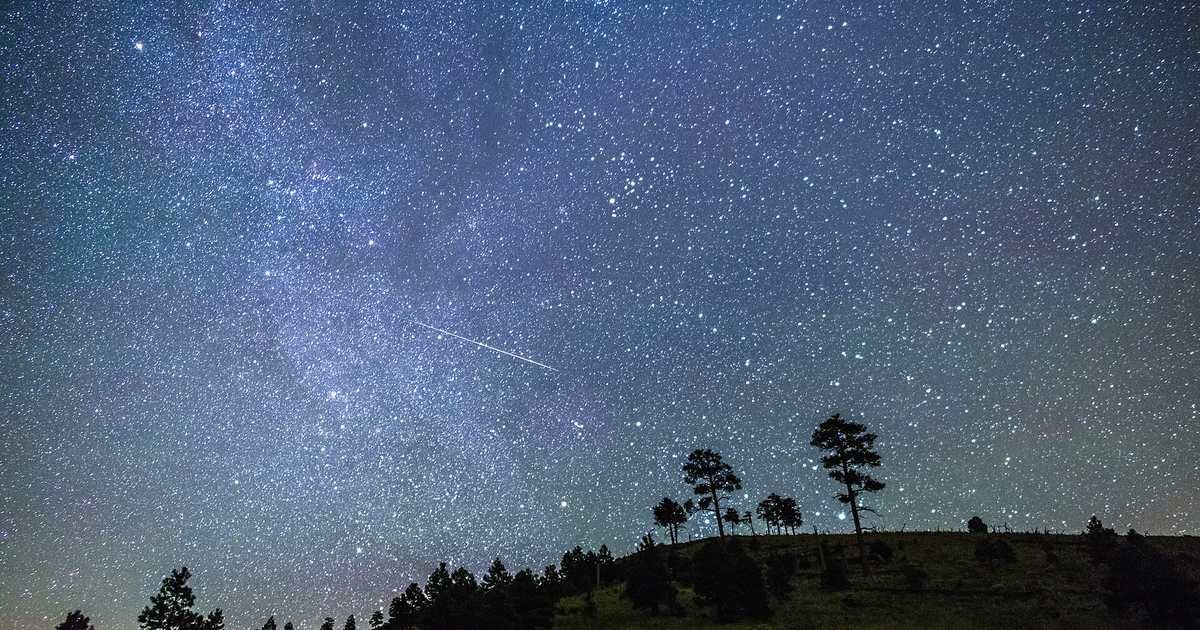
Photo: Wikimedia Commons · Public domain
October is one of the best months of the year for skywatching. Early in the month came the Draconids, a meteor shower famous for being unpredictable, and in the second half of the month the Orionids reach their peak, made of fragments from Halley's Comet. You don't need a telescope to see them: just a dark spot, some patience and a blanket.
What a meteor shower is
"Shooting stars" aren't stars at all. They're tiny particles of dust and rock, many no bigger than a grain of sand, that enter Earth's atmosphere at tens of kilometers per second. Friction with the air heats them until they vaporize, leaving a streak of light that lasts a fraction of a second.
When Earth, on its orbit around the Sun, passes through the trail of dust left by a comet, we get a meteor shower. Because Earth crosses those trails on the same dates each year, showers are annual. They all seem to come from one point in the sky, the radiant, and each shower is named after the constellation where its radiant lies.
The Draconids: the unpredictable one
The Draconids come from Comet 21P/Giacobini-Zinner and appear to stream out of the constellation Draco, the Dragon, in the northern sky. Most years they're modest, with just a few meteors an hour. But every so often they surprise: in 1933 and 1946 there were true meteor storms with thousands per hour, and in 2011 and 2012 there were notable outbursts. That's why astronomers keep an eye on them every year: you never quite know what will happen.
One advantage: they're best seen in the evening rather than before dawn, because the radiant is high in the early part of the night. From the Southern Hemisphere they're hard to see, since Draco sits very low or below the horizon.
The Orionids: bits of Halley's Comet
Halley's Comet swings past the Sun roughly every 76 years (the last time was 1986 and the next will be 2061). But you don't have to wait: twice a year Earth passes through the debris it has left behind. In May it produces the Eta Aquariids, and in October the Orionids.
The Orionids usually peak around October 21, with about 10 to 20 meteors an hour under good conditions. They're fast and sometimes leave lingering trails. Best of all, they can be seen from both hemispheres, because Orion is visible from almost everywhere on Earth. The best time is after midnight until just before dawn.
How to watch: a practical guide
- Get away from city lights. Light pollution is the biggest enemy. A park on the edge of town, the countryside or a beach is ideal.
- Check the Moon. A bright Moon washes out fainter meteors. Nights near the new moon are best.
- Let your eyes adjust. They need 20 to 30 minutes to get used to the dark. Don't look at your phone, or use a red-light mode.
- Lie back and look up. You don't need to stare at the radiant: meteors can appear anywhere in the sky. A reclining chair or a blanket on the ground is perfect.
- Dress warmly. October nights can be chilly, even in mild climates.
- Be patient. Meteors come in bursts. Give it at least an hour.
How to photograph them with your phone
Many current phones have a night mode or a "pro" mode that allows long exposures. A few tips:
- Use a tripod or rest your phone on a stable surface.
- Turn on night mode or set an exposure of 10 to 30 seconds if your camera allows it.
- Focus manually at infinity and turn off the flash.
- Use the self-timer so you don't shake the phone when you tap.
- Take lots of shots in a row: catching a meteor is a matter of luck.
Beware of photos that look "too perfect"
Every time there's a meteor shower, spectacular images spread online showing dozens of meteors streaking over a landscape. Many are real, but they're composites: dozens or hundreds of photos taken over hours and merged into one. Others are AI-generated. With the naked eye, it's normal to see one meteor every few minutes, not a continuous downpour like in the movies.
Are they dangerous?
No. The particles are so small that they burn up 80 to 100 kilometers above the ground. None reach the surface. Meteorites that do hit the ground usually come from asteroids, not from these showers.
What's next in the sky
After the Orionids come the Taurids in November, known for slow, bright "fireballs", and the Leonids in mid-November. In December, the Geminids are usually the strongest shower of the year. A great excuse to get outside, unplug and look up.
For information only. It does not replace advice from a health professional. Medical disclaimer
You may also like
 Health
Respiratory virus season is here: flu, COVID and RSV, and how to prepare this fall
 Viral world
The year's funniest animal photos are taking over social media again: the contest that makes us laugh and protect nature
 Home remedies
Ginger for nausea: what the evidence says and how to use it safely
 Health
Glucose monitors on your arm: useful for everyone or only for people with diabetes?
 Animals
The Amazon's "ghost dog": the wild canid almost no one has seen, now being revealed by camera traps
 Relationships